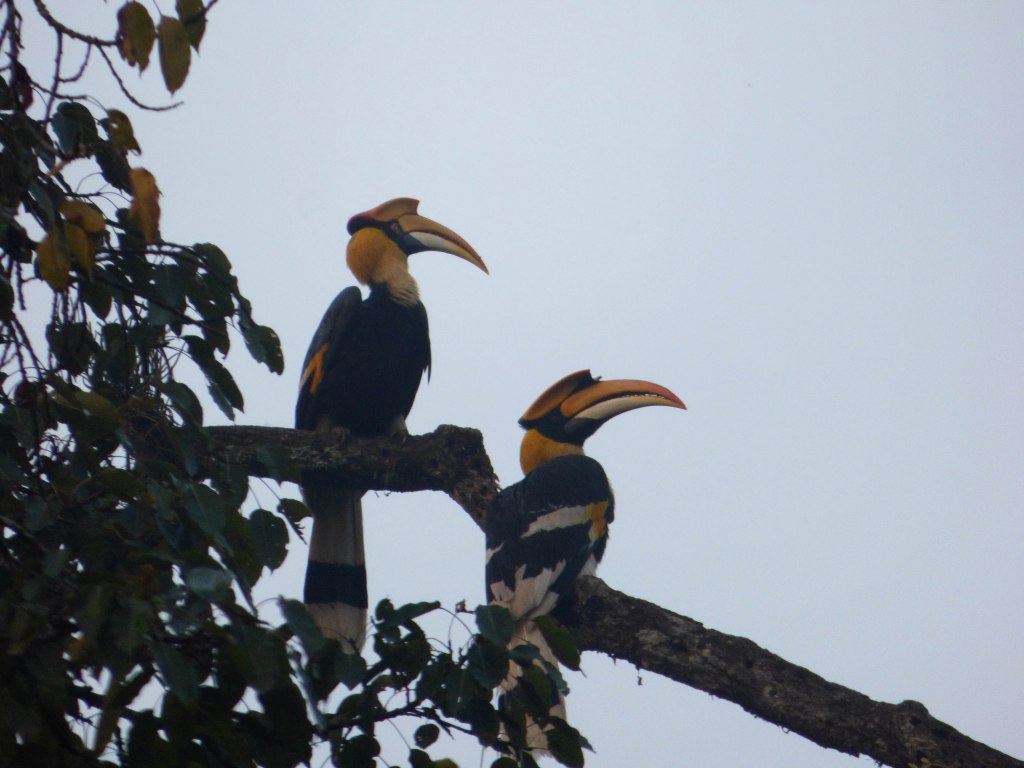
“How much does a Hornbill cost?” asked the boy to the nature guide, who’d helped him spot the hornbills flying to their roost site during dusk. I was a witness to this spectacle, but the question, like the autumn air, faded away in time.
A few years later during graduate school, I started learning the concepts of ‘ecosystem services’ and ‘ecological economics’, which deals with putting a price on the elements of nature and the services obtained from them. These elements directly or indirectly contribute to our well-being.
The boy’s question, which seemed ‘useless’ to me back then, started echoing in the cortex of my brain as I engaged with the concept of ‘Value of Nature’. Soon, the lockdown happened and as the world muscled a pandemic, I got the time to mull over this question and fiddle it with perspectives rarely thought about.
When I was studying Hornbills for my project, I used to meet poachers, nature guides, tourists, and various other stakeholders. Everyone had a different value for the same object (the object being a living thing – the Hornbill). From our common sense, we can deduce that the value for the same object differs with the changing utility. To put in the context of Hornbills – for a poacher the value was Rs.1500-1700; for a tour guide, Rs.5000 – Rs.6000 (since the fee for a day trip is like Rs.1500, and usually tourist stay for 2-3 days); for the government – 30% of the GDP (Latpanchar village, famous for sighting and photographing nesting pair of Rufous-necked Hornbill, in Kurseong Block in Darjeeling earned revenue of Rs.20 lac/year (2011), which is 30% of the GDP of the Kurseong Block). Looking at all the gigantic differences among these figures, like all of you even I got more confused as ‘what is the actual price of the Hornbill’.
But, when we are talking about placing value on nature, people do take it negatively and argue that putting a price tag means losing out the intrinsic value of nature and inviting capitalism to rule. In reality, that might not be the case. The above example of Hornbill does showcase the value of nature changes with the exclusive services perceived by the stakeholders from the natural element. Therefore these values from the stakeholder or policymakers, point of view makes it easier to validate and understand the cost of replacement or reimbursement needed in case of the absence of its services.
For better understanding, let’s take another realistic approach. Well, what would have been the price of the CoVID-19 virus a decade back for an experimental lab? Well, maybe a few thousand rupees. But what now in the current context is the value? To help in contextualize, only the economic loss (leaving the deaths and human emotions) caused due to the CoVID-19 is near 10 trillion USD, which is more than the GDP of Japan and Germany together. So does that mean the value of CoVID – 19 virus in the current time, is the financial impact of virus or the economic value of medical treatments (Vaccines and therapeutics) needed to survive, which one ?


 shomeclicks
Leave a comment